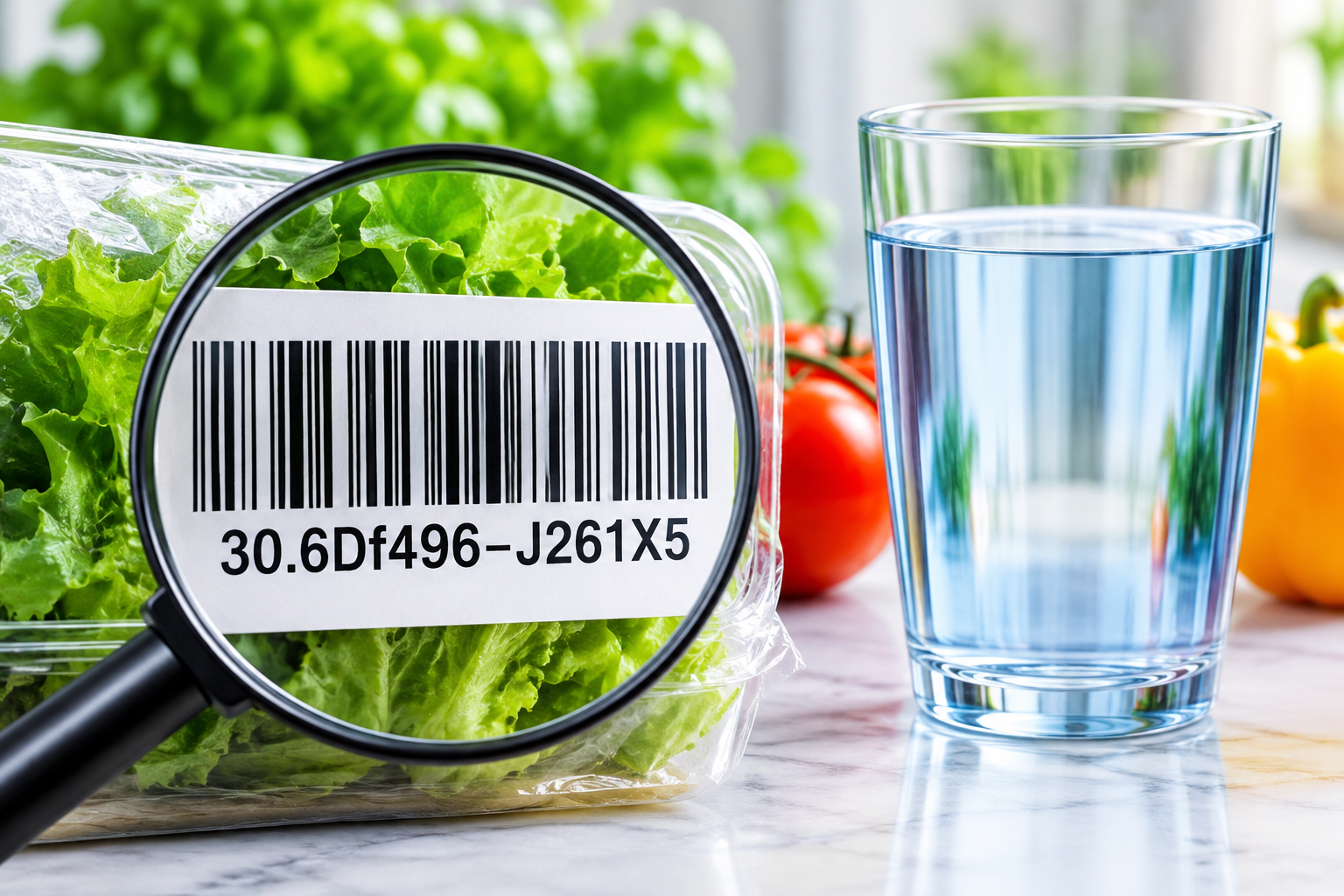
If you saw the code 30.6Df496 on a food label, a milk carton, a bottled drink or a supplier invoice, here is a quick and honest answer before anything else. Unintentionally, this single string has become one of the internet’s oddest food searches, and it’s not all that hard to see why.
This is the resolution most people would like. The rest of this article gives an explanation of the purpose of such a string, the meaning of 30.6df496–j261x5 in food and cooking and milk and what 30.6df496–j261x5 appears to mean, and how to test any code without guessing. The brief version of the digital-age mystery: The food itself hasn’t changed, but the label itself has become a database entry.
Each of these parts Signals Something Different
Food-traceability codes are typically constructed from segments, which, when combined, appear random, e.g., 30.6Df496–J261X5. There is no universal registry that holds this string, but it is shaped like a well-known batch/bos family of identifiers. Let’s try to make sense of the pattern behind 30.6df496–j261x5.
What is the Purpose of these Codes on Food Packaging?
Once upon a time, a can of tomato had a ‘best before’ date and that’s all. Today, dozens of data points can be traced back to the same can: the farm lot, the quality of the wash water, the processing temperature and the truck it was transported in. This was an idea that was pushed by regulators. The FDA Food Traceability Rule (part of the Food Safety Modernization Act) requires certain high-risk foods to have records that will allow a batch to be traced forward and backward in seconds — and codes like 30.6df496–j261x5 are how that linkage is stored. That’s the literal truth behind 30.6df496–j261x5 on food: it’s the tip of the iceberg of an invisible tracking system.
The official regulation page from FDA provides a detailed explanation of why so much of what is found on a modern shelf is labeled “key data elements” or “critical tracking events”.
Can I Cook With 30.6Df496–J261X5?
This is the search most feared by people and let’s get straight to the point. The question “can I cook with 30.6df496–j261x5” implies that this code is a component of cooking, like a powder, a liquid, or some other kind of additive that can be mixed into a pot. It isn’t. No 30.6df496-j261x5 is on any shelf, there is nothing to measure, heat, blend. If you ask “can I cook with 30.6df496–j261x5”, you can put your head in the sand and go back to your old system.
When people inquire about 30.6df496-j261x5 for cooking, they have nearly always seen a code next to a food product – on its packaging, a recipe-kit insert or a supplier sheet. Cooking 30.6df496–j261x5 just means that the ingredient you are using was from a traceable, logged batch. It is not a recipe ingredient, it is a quality indicator. You can therefore cook the food that the code is attached to — but not “cook the code” itself.
The “With Water” Angle — Decoding 30.6Df496–J261X5 With Water
Water is the most frequent search terms people use, and that’s the piece that makes it personal. There are three large sources of water in the food data, and generally, the code is located next to one of them. This relationship is all about comprehending how the measurement and logging of water in food production works.
When you see 30.6df496–j261x5 with water, you will most likely see a traceable record of a specific batch trace to a specific water measurement. It’s not alarming, it’s reassuring: it means that someone has the ability to say “where this exact water came from and was it safe?” That’s just the food-safety system working quietly in the background.
Because dairy codes are so detailed, 30.6Df496–J261X5 In Milk outlines some of the reasons why they are so specific
As one of the most-tracked products on the planet, it is no surprise that 30.6df496–j261x5 arose in milk. Milk is perishable, travels through a cold chain and is batch recallable, meaning that every carton is associated with a batch record from the farm to the pasteurization run to the fill line to the washing of the equipment with water.
You found 30.6df496–j261x5 in a carton of milk, and it’s quite similar to a lot code, except that it serves as a pointer to trace that carton back to an individual production window. When you mix the dairy and hydration bits together, you get the overlap that many searchers are aware of: 30.6df496–j261x5 (with water added together with dairy) and 30.6df496–j261x5 (with water alone added with dairy).
How Traceability Codes Move Through the Supply Chain
It’s important to think about how many hands reach one food batch to appreciate one small string. Each handoff is considered a “critical tracking event”, and the code comes with the product, much like a passport being stamped. That’s the device that powers 30.6df496–j261x5 anywhere it finds itself in the food chain.
The grammar has been established by international standards bodies. There are two main sources of formal documentation on the structure of serialized identifiers: the GS1 standards and the guidance on data identifiers provided by NIST (National Institute of Standards and Technology).
Blockchain, Sensors, and the New Layer of Trust
These codes are more prominent now because they have been adopted as the foundation for newer technologies. Temperature and moisture are automatically recorded by sensors in the IoT. Some suppliers record batch information to a tamper-proof register where a code cannot be “hacked” into the batch. Leaders in the retail sector, such as Walmart, have long demanded leafy-green growers implement digital traceability, allowing them to locate a contaminated lot in mere seconds as opposed to days. That’s the human-readable end of the machinery, a code such as 30.6df496–j261x5.
Some common misreadings to avoid:
The string appears to be scientific and is misinterpreted. These are cleared up and help eliminate anxiety, particularly for those who are wondering whether they can use 30.6df496–j261x5 to make cookies.
How To Verify Any Food Code Like a Pro
The verification procedure for any string on your groceries, like 30.6df496–j261x5, is the same. Follow it in order.
Step-by-step
- 1. Determine the source object – Is it packaging, a receipt, lab report or shipping document?
- 2. Capture context — Record the brand, product, date and any nearby text “LOT” / “BATCH”.
- 3. Scan QR/barcodes — Often leads to the same record in a more user-friendly format.
- 4. Visit the official brand or regulator website – Enter their recall/traceability database.
- 5. Quality Assurance via email or phone with full code and pictures.
Wherever water, milk or drinks are involved, the WHO guidelines on drinking-water quality and EFSA publications on food safety offer a definitive source of information on what “safe” even means. The WHO drinking-water quality guidelines and the WHO water and sanitation hub are good places to begin.
The Bigger Picture: Food Is Now a Data Object
The mystery of 30.6Df496–J261X5 is that you’re about to discover something that you’ve never known before: that your food has a digital twin. Each batch yields a series of records – where it was grown, how it was washed, the temperature it contained and which water passed the test. You don’t generally see the codes that do this, most of the time. Every now and then it comes out on a label or invoice and appears as some type of code. It isn’t. It’s a receipt for trust — and that’s the truest meaning of 30.6df496–j261x5 in food.
It’s a consumer-friendly change. The fewer the number of people who suffer from illness, the faster they recall. Records bearing the mark 30.6df496–j261x5 indicate water safety, dairy safety, and produce safety can be audited, and the water safety mark is the same as that of milk. And serialized codes are more difficult to counterfeit – a fake product cannot fake a valid traceability trail. These requirements are continuing to be expanded by the USDA and FDA, and you will find more codes such as this, not fewer.
What This Means Next Time You Shop
- The code is not an alarm bell, it’s a way of proving that the product is traceable.
- The term “with water” is typically associated with a quality record, rather than an added ingredient.
- Cooking questions are solved easily — you cook the food, not the code.
- No context, no code; screenshots beat codes.
Frequently Asked Questions
Can I cook with 30.6df496–j261x5?
No — you don’t have anything to cook with. The answer to can I cook with 30.6df496–j261x5 is that the 30.6df496–j261x5 listed on a batch/traceability code is not a code for an ingredient to cook, it is near an ingredient and printing the batch/traceability code. Prepare food as usual.
What does 30.6df496–j261x5 in food mean?
The identifier 30.6df496–j261x5 in food is a serial number that identifies a batch of food and its safety and production history. It does not indicate the food itself, but the information on the food.
Why does it appear as 30.6df496–j261x5 with water?
A water point is included in the water point field of the often record for the record 30.6df496–j261x5 with water points to.A moisture reading or a water-based beverage batch is often included in the water point field of the record 30.6df496–j261x5 with water points to. “With water” means “in water”.
What about 30.6df496–j261x5 in milk?
Dairy is highly monitored and a lot number such as 30.6df496–j261x5 in milk is the same as a carton lot number, and can be traced for quick recall.
Is 30.6df496–j261x5 an additive or E-number?
No, additives are identified by E-numbers or INS numbers. 30.6df496–j261x5 is a batch/traceability identifier used in a series of 30.30.6df496–j261x5 is a serialized batch/traceability identifier 30.