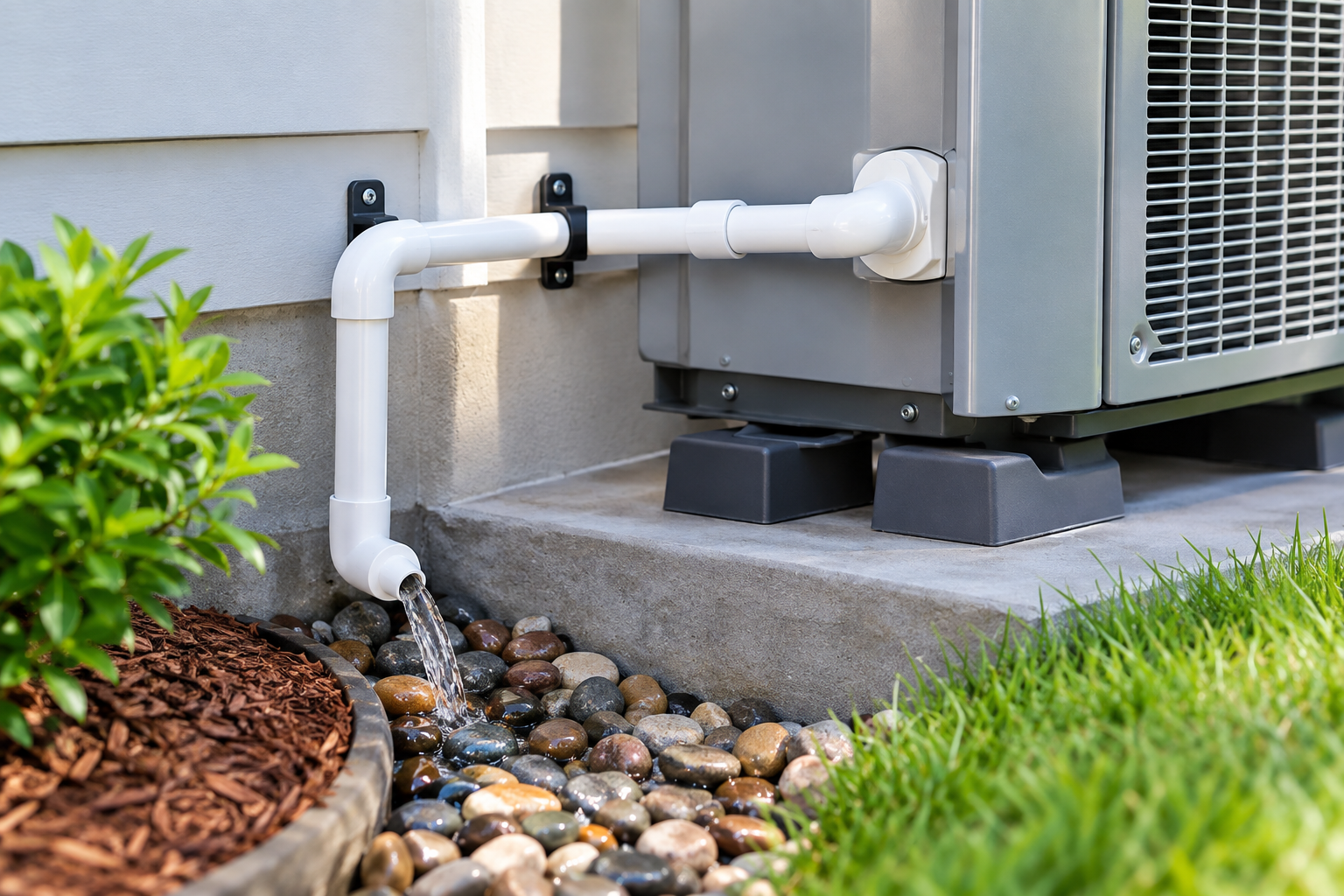
However, summer temperatures can push your air conditioner to its limits — and cooling your home is just the beginning. Each time your AC removes moisture from the air, it needs to be removed from the indoor unit. Its movement is aided by the condensate drain line.
As water begins to back up, a small leak can end up leaving a full drain pan, water around the unit, and all the mess that’s a household nightmare.
What is a Condensate Drain Line?
Your air conditioner also dries the air out while cooling your home. The moisture collects on the evaporator coil and drips into the condensate pan or drain pan and flows through the condensate drain line, where it goes out safely.
Many residential households have the condensate line as a small PVC pipe attached to the indoor unit. Your systems might also have a condensate trap that aids the line drain effectively as water circulates round the HVAC system. Although it is a relatively simple component, it performs an important function of the air conditioner, each time it is used.
What is the Location of the Condensate Drain Line?
Typically, the drain line for the condenser is located near the indoor unit instead of the outdoor condenser. It may be in a basement, attic, closet, and so on, or it could be in a garage or utility room.
It’s easiest to identify if you are looking for it: A white or light-colored AC drain pipe leading to the inside section of the system. The line can be connected to a floor drain, a condensate pump or to an approved drain located outside the house. But some AC units have a back-up line in case the primary line clogs.
Does a Water-filled AC Drain Line Mean Trouble?
Yes, during cooling season, there will be some water in the AC condensate drain which is perfectly normal. When your air conditioner removes humidity, it forms condensation, which should flow through the line during operation. That water flows out of the healthy system at a regular rate. Typical leaks that are associated with a drainage problem are standing water in the drain pan, wet spots around the indoor unit, stains around the line or leaking in the wrong location.
What happens when the AC Condensate Drain Clogs?
Dust, algae, sludge and debris can build up in the line over time. If there is an accumulation that reduces the opening, water flow begins to slow down. As the clog increases the line may become blocked and prevent the line from draining and the condensate pan may fill up.
This backup can cause a number of issues with your air conditioner:
- Irrigate around the indoor unit: A clogged AC drain line can cause it to expel water from the drain pan and onto the floor, particularly in heavy use.
- Damage to adjacent property: If moisture continually builds up in one place, it can negatively affect drywall, flooring, insulation and wood framing.
- Musty smells: The area around the condensate line and drain pan is damp, providing an ideal setting for mildew and other growth to flourish.
- System shutdowns: Some have a safety switch, which switches off the AC if water gets too high in the pan.
When your drain line clogs, it’s usually a small problem that you can easily miss. An AC condensate drain will start to give off a slight smell, a bit more moisture, or the pan will continue to fill up, and it’s time to clean it.
More Related Articles:
- How Much Does HVAC Repair and Maintenance Cost?
- How Do You Clean the Condensate Pump on Your AC Unit?
- How to Clean Your AC Filter in 7 Simple Steps
- The Do’s and Don’ts of HVAC Maintenance.
- How Much Does It Cost to Replace an AC Compressor?
Where Can I Drain My Condensate Line?
The condensate drain line in many homes leads to a floor drain, utility sink, condensate pump or an area outside the home where the water can be safely drained. If this path is functioning properly, then water will exit the indoor unit rather than accumulating in the drain pan or around the unit.
This is because with each set-up the drain will vary depending on the system design and local codes. When replacing a line where the water is drained, consult the manufacturer’s instructions and local regulations, to ensure that the system continues to convey water away in an appropriate manner.
How to Clean a Condensate Drain Line
Always inspect the drain pan and the obvious drain pipe opening for sludge, debris or water. A wet/dry vac attached to the outside end of the PVC pipe may be able to remove the clog if it is a simple blockage. Then, flushing a cup of warm water or AC line cleaner into the access point may be helpful to clear the residue.
Some careful steps can help to clean the drain:
- Turn off the power. Safety always has to be the first concern when working around the indoor unit.
- Check the condensate pan. When the water in the pan keeps building up, it indicates that the water may be draining slowly or the drain may be completely clogged.
- Use a wet-dry vac. If the clog is in the outside drain opening, it can be removed by strong suction.
- Flush the line. Pour a cup of water or approved cleaner through the drain access point to help clean the drain.
- Look for good drainage. If the flow is smooth, the line will likely be open again.
Other clogs require more than a quick flush. When a series of backups, concealed pipelines, heavy accumulation or water damage near the unit require attention, a closer look may be warranted. For those situations, professional service can assist them identify the source of the blockage and ensure the rest of the system is draining as it ought to be.
Why the Condensate Drain Line Matters
The condensate drain line is a very mundane item, and most homeowners don’t spend much time thinking about it, which is appropriate. Typically operates silently, in the background. But if it becomes clogged, a minor drainage problem can become a big mess.
Cleaning the condensate line will make it easier for your air conditioner to do its job. Monitor the drain pan, watch for puddles or musty odors and take action early if drainage is slow. With such a water-moving part, a bit of maintenance goes a long way.