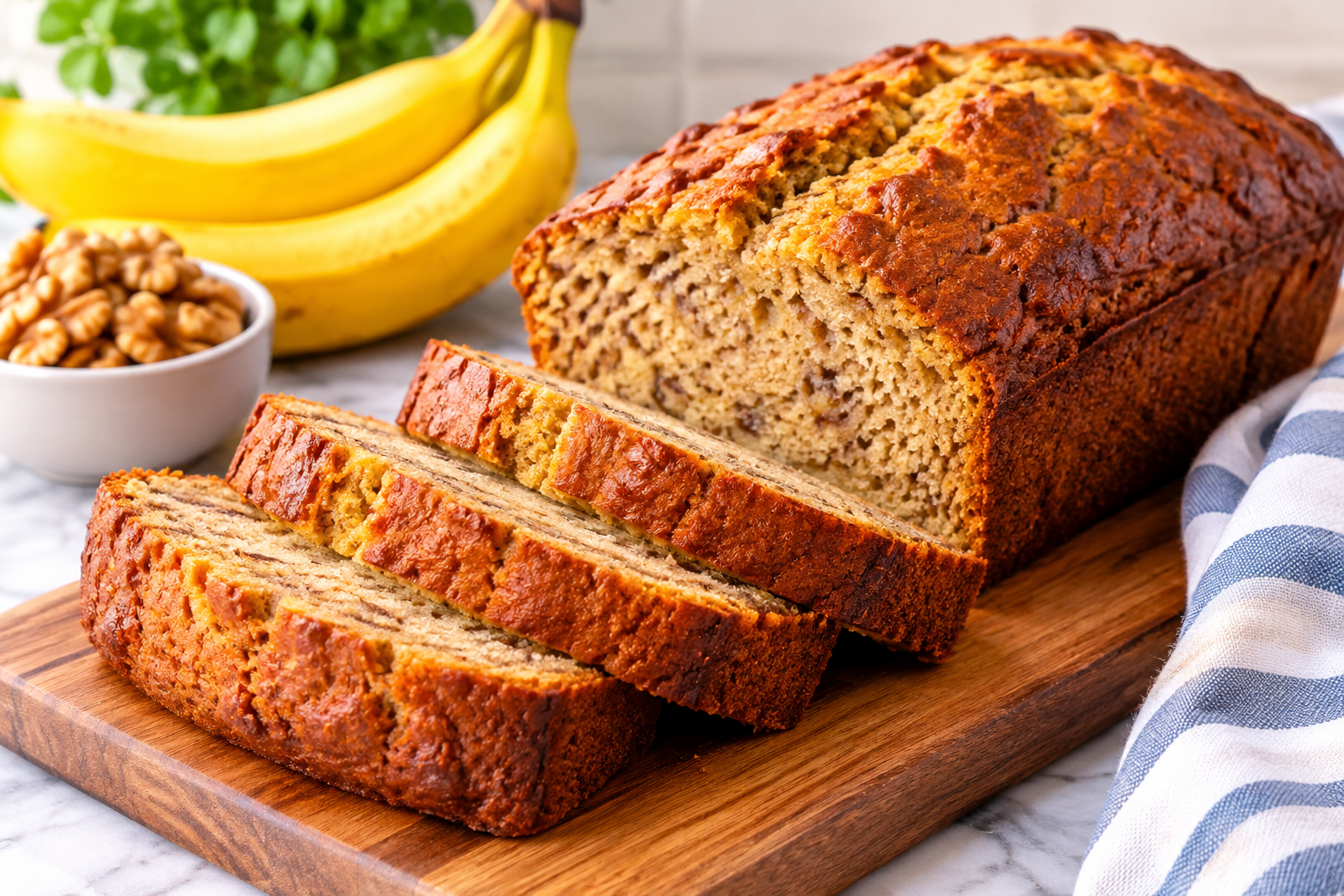
Banana bread stands as a quintessential homemade baked confection, renowned for its exceptional taste and comforting appeal.
The loaf’s tender crumb, the inherent sweetness derived from ripe bananas, and its intoxicating fragrance render it an ideal selection for morning repasts, afternoon interludes, and familial celebrations. Be you a seasoned artisan in the kitchen or a novice attempting your inaugural bake, crafting banana bread within the domestic sphere remains an accessible and gratifying endeavor.
A notable virtue of this recipe lies in its capacity to repurpose overripe bananas, thereby preventing potential food waste.
When combined with a select array of fundamental kitchen staples, these fruits yield a loaf that is both succulent and deeply aromatic, appealing to a wide audience. Further, the formulation offers considerable versatility, allowing for customization with chocolate chips, walnuts, cinnamon, or any other preferred additions.
This comprehensive guide elucidates the preparation of an effortless banana bread recipe, detailing the requisite ingredients, offering indispensable baking techniques, and presenting inventive variations to elevate your homemade dessert to new heights of culinary excellence.
Why Homemade Banana Bread Is So Popular
The enduring appeal of homemade banana bread stems from its seamless integration of simplicity, economic accessibility, and exceptional taste.
Distinct from elaborate culinary preparations, this recipe demands neither costly instrumentation nor specialized professional expertise to execute successfully.
The inherent sweetness and moisture of ripe bananas are complemented by the soft, satisfying texture achieved through the incorporation of staple ingredients such as flour, eggs, butter, and sugar.
Among the compelling motivations for savoring homemade banana bread are the following:
- The recipe relies on uncomplicated components, the majority of which are typically found within a standard kitchen inventory.
- The batter requires no elaborate methods to prepare, allowing for a straightforward and uncomplicated process.
- To minimize food waste, overripe bananas may be repurposed into a delectable confection.
- The selection boasts customizable flavor profiles, allowing for the incorporation of nuts, chocolate, or dried fruits.
- Ideal for sharing, a freshly baked loaf is perfectly suited for family gatherings and celebrations.
Ingredients Needed for Easy Banana Bread
To streamline the baking process, ensure that all requisite ingredients are gathered before commencing.
Main Ingredients
- 3 ripe medium-sized bananas
- 2 cups all-purpose flour
- ½ cup melted butter
- ¾ cup granulated sugar
- 2 large eggs
- 1 teaspoon baking soda
- 1 teaspoon vanilla extract
- ¼ teaspoon salt
- ½ teaspoon ground cinnamon (optional)
- 2 tablespoons milk (if needed)
- Optional Add-ons
Incorporating supplementary ingredients offers a means to enhance both the flavor profile and textural complexity.
- ½ cup chocolate chips
- ½ cup chopped walnuts
- ¼ cup raisins
- ¼ cup chopped almonds
- A small amount of shredded coconut
Incorporating these elements is entirely discretionary, allowing you to tailor the composition to your personal preferences.
Step-by-Step Guide to Making Banana Bread
Crafting homemade banana bread is an uncomplicated endeavor; adhere to the following procedure to produce a loaf distinguished by its tender crumb, succulent moisture, and rich flavor profile.
The initial phase necessitates the preparation of the oven and the baking pan.
Set your oven to 175°C (350°F) and prepare a standard loaf pan by greasing it with butter or cooking spray; additionally, lining the pan with parchment paper will facilitate the removal of the baked banana bread once it is done.
Preparatory measures taken before baking the pan serve to inhibit the adhesion of the batter.
Step 2: Mash the Ripe Bananas
Remove the skins from the bananas and transfer the fruit into a spacious mixing bowl.
Employ a fork or a potato masher to crush the bananas thoroughly, ensuring they are reduced to a perfectly smooth consistency.
Incorporating a modest quantity of chopped banana is entirely acceptable, as these fragments contribute a desirable textural element to the final loaf.
To achieve optimal flavor, select bananas that exhibit brown spotting on their skin, as these fruits tend to be notably sweeter and possess a texture that yields more readily to mashing.
Step 3: Mix the Wet Ingredients
Incorporate melted butter and sugar into the mashed bananas, blending the ingredients until they are thoroughly and uniformly combined.
Subsequently, incorporate the eggs and vanilla extract, whisking delicately until the composition achieves a perfectly smooth consistency.
Ensure the melted butter has cooled sufficiently to avoid scorching the eggs before incorporation.
Step 4: Combine the Dry Ingredients
In a separate bowl, combine all-purpose flour, baking soda, salt, and cinnamon.
Blend the components uniformly to ensure the baking soda is thoroughly dispersed throughout the flour.
Incorporate the dry mixture into the banana base incrementally, stirring delicately until complete homogeneity is achieved.
Overmixing must be avoided, as it can render the banana bread dense rather than yielding the desired soft texture.
Step 5: Add Your Favorite Ingredients
For those who crave additional layers of flavor and texture, incorporate chocolate chips, chopped walnuts, raisins, or almonds into the batter.
The incorporation of these ingredients furnishes a delightful counterpoint to the banana’s inherent sweetness.
Set aside a modest quantity of chocolate chips or nuts to be scattered across the surface before baking.
Step 6: Transfer the Batter to the Pan
Pour the prepared batter into the greased loaf pan.
Utilize a spatula to distribute the material uniformly across the surface.
To eliminate substantial air pockets, one may gently strike the pan against the kitchen countertop.
Step 7: Bake Until Golden Brown
Position the loaf pan within the preheated oven and maintain it there for a duration of approximately fifty to sixty minutes.
The requisite baking duration fluctuates contingent upon the specific thermal characteristics of your oven and the dimensions of the baking vessel.
To ascertain doneness, insert a toothpick into the core of the loaf; it signals readiness if it emerges clean or retains only a trace of damp crumbs, indicating the banana bread has completed its baking cycle.
Should the upper crust darken prematurely while the core remains undercooked, gently shield it with aluminum foil.
Step 8: Cool and Serve
Extract the banana bread from the oven and permit it to rest within the pan for roughly 10 to 15 minutes before removal.
Once removed from the heat, place the item upon a wire rack to facilitate continued cooling before slicing.
It may be served unadorned, or one might enhance its flavor by pairing it with butter, honey, peanut butter, or an assortment of preferred beverages.
Tips for Making Perfect Moist Banana Bread
Employing a handful of straightforward baking methodologies can profoundly elevate the ultimate outcome of the finished product.
Choose Very Ripe Bananas:
The attainment of optimal flavor relies fundamentally upon the presence of ripe bananas; those marked with brown spots not only exhibit a heightened sweetness but also deliver superior moisture content.
Avoid Overmixing the Batter
Combine the ingredients solely until the flour is fully incorporated; excessive mixing will overdevelop gluten, yielding a dense and tough loaf.
Measure Ingredients Carefully
Precise quantification is essential for preserving the optimal equilibrium between moist and dry components.
An excess of flour, conversely, may result in bread that lacks moisture and texture.
Check the Baking Temperature
Maintaining a moderate oven temperature ensures the banana bread bakes with uniformity.
It is essential to verify that the center is fully cooked before removing the loaf from the oven.
Allow Proper Cooling
Allowing the loaf to cool facilitates its structural stabilization and ensures a clean slice; attempting to cut it prematurely may result in the crumb collapsing.
Delicious Banana Bread Variations to Try
A significant benefit of this effortless banana bread recipe lies in its remarkable adaptability to diverse personal preferences.
Chocolate Chip Banana Bread
Incorporating chocolate chips into the batter imparts a deeply rich and sugary profile, rendering this variant exceptionally favored among both children and devotees of chocolate.
Walnut Banana Bread
The inclusion of chopped walnuts introduces a pleasing crunch and rich nuttiness that beautifully contrasts with the tender crumb of the banana loaf.
Healthy Banana Bread
To achieve a lighter variation, substitute a portion of the all-purpose flour with whole wheat flour while simultaneously reducing the quantity of added sugar.
Alternatively, you may incorporate plain yogurt in place of some of the butter.
Vegan Banana Bread
A vegan alternative may be crafted by incorporating plant-based milk, vegetable oil, and appropriate egg replacements, such as ground flaxseed combined with water.
Cinnamon Banana Bread
The incorporation of cinnamon, complemented by a modest quantity of nutmeg, yields a rich, aromatic profile that is particularly savored throughout the colder seasons.
How to Store Homemade Banana Bread
Adhering to appropriate storage protocols is essential for preserving both the freshness and structural integrity of homemade banana bread.
Once the loaf has reached full thermal equilibrium, it should be placed within an airtight vessel and maintained at ambient temperature for a duration of approximately two to three days.
To extend the shelf life of the product, store it within a sealed container in the refrigerator for up to seven days; alternatively, you may preserve individual slices or the whole loaf by freezing them for a duration of approximately two to three months.
Upon readiness, permit the frozen slices to thaw naturally or gently reheat them in a microwave or oven.
Best Ways to Serve Banana Bread
Banana bread stands as a remarkably versatile treat, adaptable to numerous occasions.
A warm slice, accompanied by butter, serves as an ideal simple breakfast, while pairing the same loaf with coffee or tea creates a perfect afternoon snack.
For those seeking a more decadent finale, one might supplement the offering with a generous scoop of vanilla ice cream, a drizzle of chocolate sauce, or an assortment of fresh fruit.
Alternatively, lightly toasting the remaining slices yields a warm, delicately crisp confection.
Conclusion
Crafting an uncomplicated banana bread serves as an exquisite method to indulge in homemade confectionery, obviating the need for elaborate preparation or costly provisions.
By utilizing fully ripened bananas, fundamental pantry essentials, and a mere handful of straightforward procedural steps, one can fashion a tender, succulent, and delectable loaf that remains equally suitable for myriad occasions.
Whether one favors the traditional banana bread or seeks out chocolate chip infusions and healthier variants, this recipe affords ample scope for culinary experimentation.
Success hinges on selecting ripe bananas, executing precise measurements, and refraining from overmixing the batter; adhering to these principles ensures consistently delectable outcomes.
Homemade banana bread transcends the realm of a mere baked confection; it stands as a deceptively simple yet profoundly comforting recipe that fosters familial unity and imbues the mundane with a touch of sweetness.